












The Story Behind The Branford Buzz
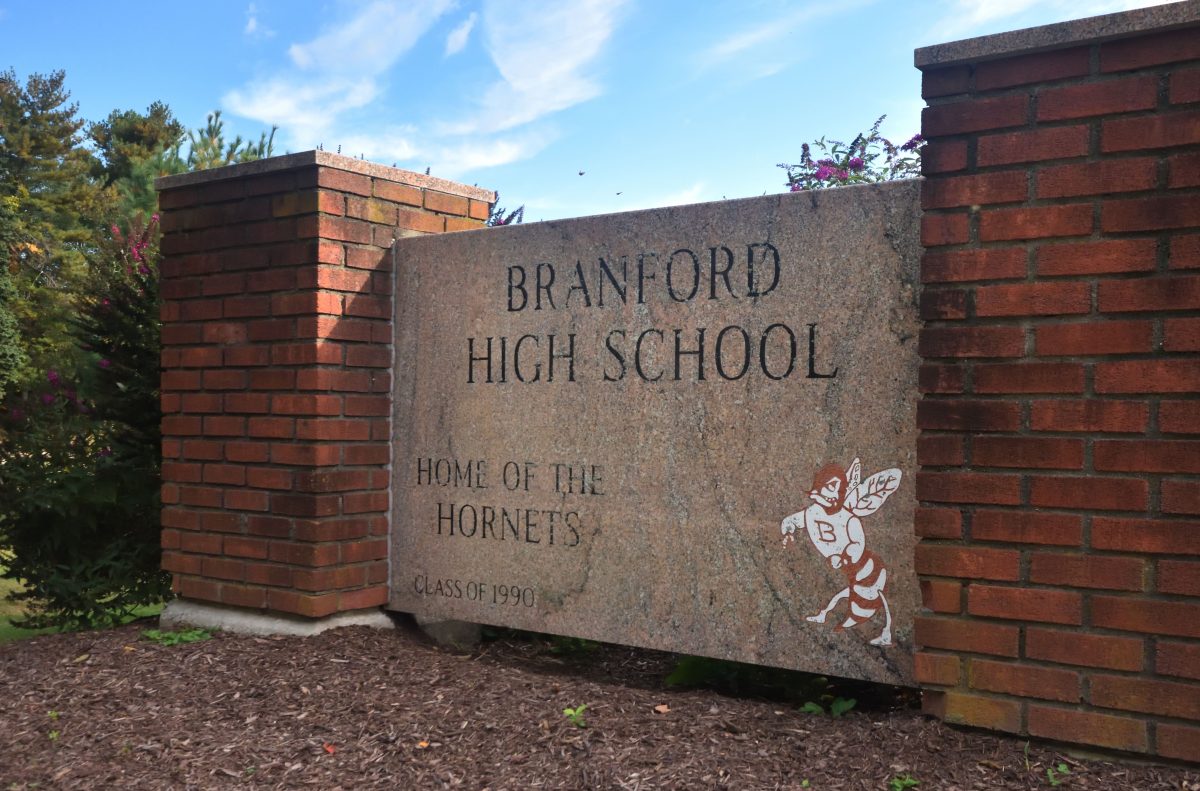
The Branford Buzz is a student-run newspaper that has documented aspects of student life at Branford High School since its founding during the 1937–38 academic year. Originally published under the title The Hornet, the newspaper has undergone several name changes and format shifts over the decades, ultimately evolving into an online-only publication. Although early print issues have not survived, the newspaper’s existence and early mission are documented in contemporaneous school records.
A paper ‘deserving much note and credit’
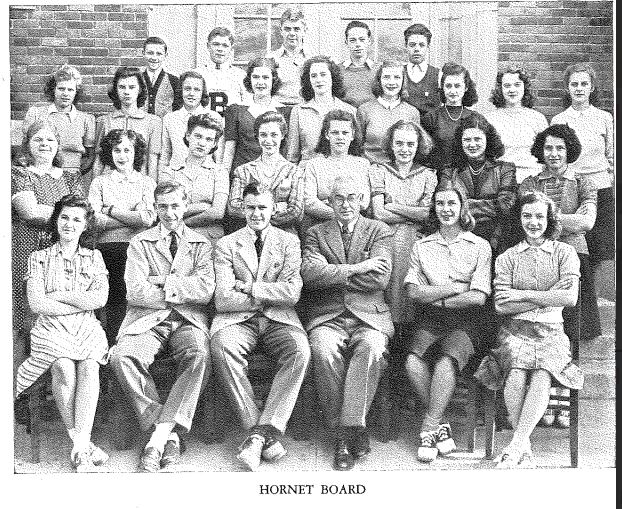
The publication was founded in the 1937-38 school year under the guidance of longtime educator John C. Carr, who had previously served as the first principal of the “new” Branford High School building on Eades Street and later taught English, History and Latin for more than 20 years before retiring in 1943. Although early copies of The Hornet do not survive, the founding of the publication is documented in Branford High School’s 1938 yearbook, which described it as “a very recent publication whose object is to offer an opportunity to the literary and journalistic minded members of the student body.” During that school year, the yearbook entry continued, the staff of The Hornet “produced a paper deserving much note and credit.” There were 17 student staff members listed in that year’s yearbook.
The first student editor was Roberta Baldwin, who was also involved in other student-led publications, including the yearbook and the literary magazine, Beacon. Her entry in the 1938 yearbook describes her as “most industrious and most likely to succeed.”
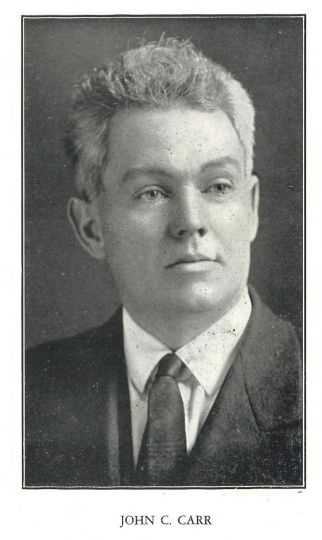
Carr, who served as faculty advisor for the first four years of the newspaper’s publication, was a guiding presence in those early years. Records from the school yearbooks from 1938 to 1942 list him as the faculty advisor to The Hornet, as well as with the yearbook and the school’s literary magazine. The yearbooks of the late 1930s and early 1940s show that many students were involved in all three publications.
The oldest surviving copy of The Hornet is from June 1940, which is kept in the archives of the Branford High School library. The issue, published on 8 ½ X 11 sized paper, is 12-pages long and features a variety of news and information in a typeset format. In an editor’s note on page 2, student editor Paul Birbarie acknowledges that there were some problems with quality of several of the issues that year and, as a result, the decision was made for the final issue to be “printed professionally.” Birbarie states in his note that the previous issues that school year – he said there were six published – featured handwritten or stenciled designs.
For the next 20 or so years of The Hornet’s publication history, very few copies survive in official records or archives. It is unclear how many issues were published each school year and what the regular production schedule was. At some point in the 1940s, the publication of The Hornet moved to a broadsheet format. This format is evident from the second oldest surviving copy, from March 1949. The lead story in that edition described the rehearsals underway for the Junior Class production of “Dark Hammock,” a psychological thriller set in the prairies of Florida.
After Carr, there were several faculty advisors to the newspaper including Irene Haglund, Mrs. Harold Barker and Marcya Brodasky.
Early evolution and changes
Throughout the 1950s and 1960s, The Hornet was published in this broadsheet format. Although only one edition from the 1950s survives – an eight-page broadsheet published November 1955 and sold for 15 cents a copy or $1.00 a year to subscribe – there are copies from several different editions published in the 1960s. The lead story of the 1955 edition features a preview of the upcoming senior play, “Crewcuts and Longhairs.” Inside are a variety of news stories ranging in topics from the annual Branford vs. East Haven Thanksgiving Day football game to brief profiles of “Girl of the month” and “Boy of the month.” According to that 1955 issue of The Hornet, there were 19 students on the staff.
Publication remained much the same throughout the 1960s when the cost to subscribe increased to $1.25 a year.
During the 1964-65 school year The Hornet underwent a new printing process for publication – photo offset. That year’s yearbook recounted the impact of such a change to the staff of The Hornet, “which is faced with extra work, typing and setting up layouts until the late, late hours,” according to an entry in the 1965 Milestone. “Despite this extra load, the quality of the newspaper has improved tremendously, and The Hornet has continued to be the voice of the student body.”
The paper continued to publish throughout the 1960s and 1970s with each era imprinting its unique style and design features on the publication. In the 1970s, for example, an issue of a publication called The Branford High Times was published, featuring an interview with legendary PE teacher Toni Cartisano.
During the 1980s, the publication had difficulty finding a consistent footing and even identity. The 1981 BHS yearbook documented such a change, stating that both the literary magazine and the newspaper were “reconstructed” with the help of advisor Palma Ruggiero. In the 1982 yearbook, the paper is listed as The Banner and boasted a 10-student staff and in 1983 the yearbook recorded that the newspaper staff “spent many hours writing the news of 1983. With the help of advisor Mrs. Palma Ruggiero, The Branford Banner had its best year yet.” The transformation continued and according to the 1986 year book, the “newspaper has gone through several changes this year. It is the first year that the stories have been published in newspaper form.” That year the paper called itself The Hornet Herald, according to the yearbook.
Publishing in the changing digital landscape
After several years of inconsistent publication and staffing, the paper got new life in the 1990s and incorporated some of the latest self-publishing software thanks to a new graphics technology class offered at the school. Student editors and writers began using newer, more accessible digital layout software to design each edition, while printing was handled in house through the school’s copy center at Walsh Intermediate School. In fact, the inaugural edition of the paper published that year – bearing the moniker “The Hornet Herald” and dated Winter 1990 – announced these changes on its front page, proudly declaring that all word processing was done on an Apple Macintosh while layout was handled by Aldus Pagemaker software.
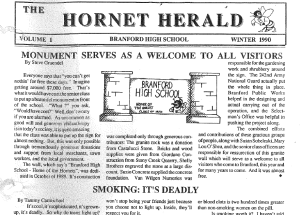
In additon to the redesign, the staff of the newspaper tackled some relevant and controversial topics including “smokeless tobacco, abortion, tattoos, and cheating,” according to the 1990 yearbook, that were in response to concerns and interests of the student readers.
“I like how the paper responded to student suggestions,” one of the editors, Kim Murray, told the yearbook in 1991. “For instance, students showed concern about the environment, so we changed the high-gloss paper that the Herald was printed to recycled paper.”
In 1992 the tranformation of the paper continued, and it changed its name yet again, this time to The Sting.
The publication’s current name, The Buzz, came about in 2000, said longtime faculty advisor Sue Butler. “I felt we needed a more powerful name,” Butler said in a 2025 interview. “Thus, The Buzz was born.”
In 2008, student staff members, under the leadership of then-editor Marissa Kaplita, decided to supplement the paper versions of the newspaper by also publishing articles online. These articles were posted online on the newly-created Branford Buzz WordPress blog site starting on Dec. 5, 2008. The first three articles, all published within an hour of one another, covered a variety of topics, from new teenage driving laws, the school’s security procedures, and a French teacher traveling to Morocco as part of an exchange program. Within a week, several other articles were published to the site and were simultaneously published in paper editions.
The migration online by The Branford Buzz reflected broader shifts in American journalism during the early 2000s as declining print circulation and increased internet access altered news production at both the professional and educational level. At the turn of the century, more families subscribed to internet services than to actual newspapers. While the media landscape shifted across the country, at Branford High School student interest in journalism – that is learning how to report, write and edit news – waned as well which led to an inconsistent publication schedule and difficulties staffing the newspaper.
For a few years, stories were published on paper and posted online through the blogging platform started in 2008. Eventually, The Branford Buzz evolved into an all-digital platform. The last paper copy of The Buzz appears to be from November 2010. The eight-page edition features a cover story on the fall play “The Man Who Came to Dinner” and reports on the visit to Branford High School of Nobel Prize winner Thomas Steitz.
By 2012, the school district secured the www.branfordbuzz.com domain and The Buzz began publishing all content there. As it has throughout its history, the paper operates independently of the school. The publication of news articles online followed an inconsistent schedule over the next decade. However, The Buzz did continue to publish during the COVID pandemic era from 2020-2022. In fact, there were several stories documenting the school’s response to the pandemic’s quarantine limitations and the impact on student life.
In May 2022, The Buzz published an article on the school’s new cell phone ban in classrooms that went into effect that month. The story, which was picked up by several statewide publications, earned the staff of The Buzz a Connecticut Press Club award in April 2023. The publication earned an honorable mention in the breaking news category.

The 2025-26 school year was the most productive period for The Branford Buzz in recent memory. Several new staff members joined and, under the leadership of editor-in-chief Owen Lentner, the newspaper underwent a redesign and continued to report on a variety of topics, including the use of AI in schools, the failing roof in the high school building, and a short-lived hacky sack craze among the student body. Their work was honored by the New England Scholastic Press Association, which awarded The Buzz a first place All New England co-winner for online newspapers in Class II — schools with between 751 and 1,500 students.
The Branford Buzz continues to publish regularly and has worked to meet the ever changing challenges in the 21st century news industry.
Despite these challenges and changes in technology, The Buzz has never stopped relying on its staff to bring the news and information to the BHS community. Over the course of its publication history, hundreds of creative, hard-working and thoughtful students have contributed to that end. Click here to see the most recent team of staff members.