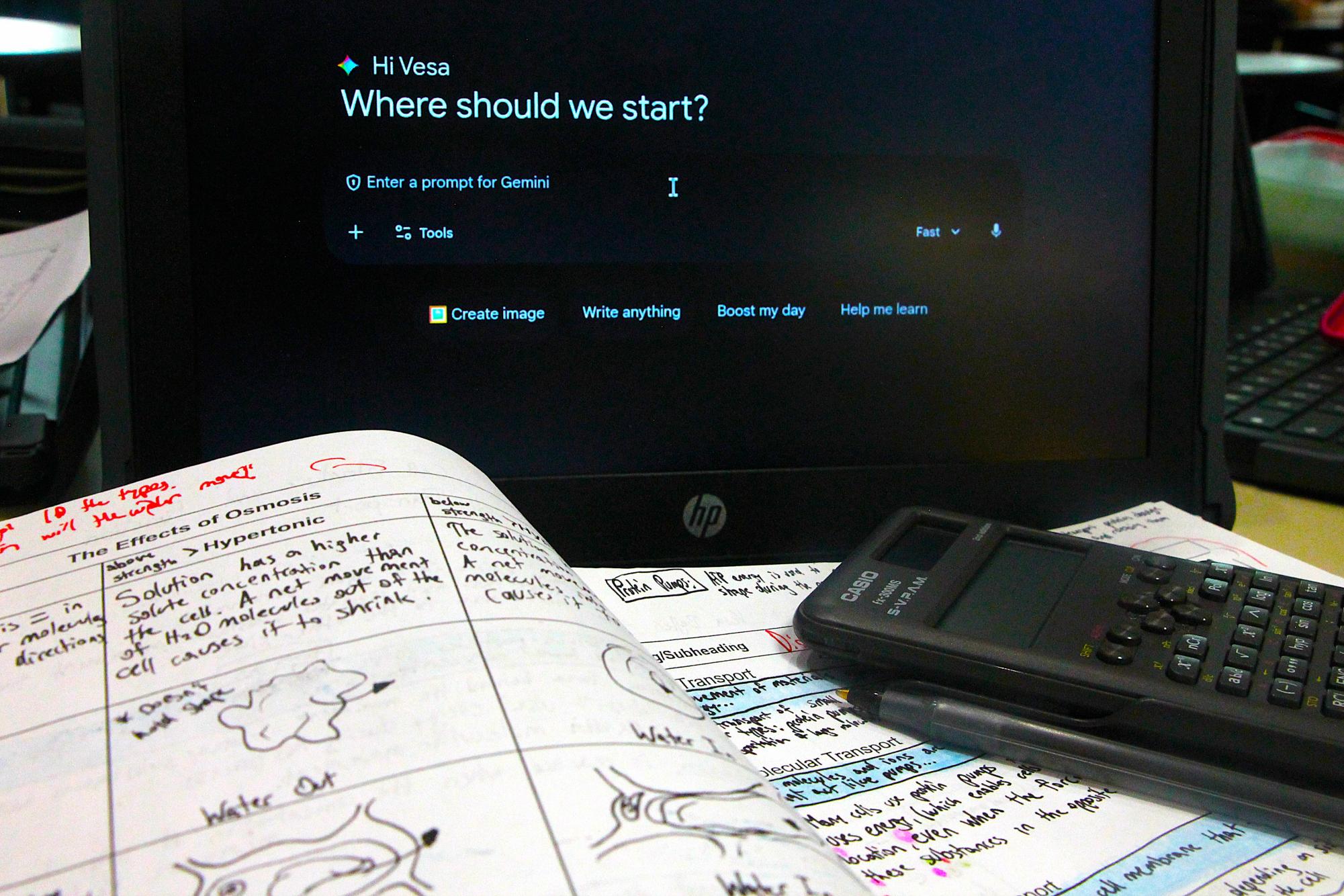

We are asking the wrong questions regarding AI in schools. It isn’t an argument of ‘ban or keep.’ It’s a question about ethics, moral understanding, and protecting academic integrity.
Years ago, the concept of artificial intelligence alone used to be so foreign that it was almost dystopian. It seemed dangerous and wrong. As the technology became more familiar, I realised that it wasn’t bad – it was just new.
It is hard to adjust to new changes, especially ones as transformative as AI, without having an open mind and being capable of compromise.
With AI integrated into nearly all aspects of our lives, including the classroom, we need to face these changes head on. However, our educational institutions are at a crossroads, struggling to decide how best to adapt – or not – to the technology.
Branford High school has not been immune to this issue.
So what action should we take to adapt education to AI? And most importantly, how do we do that without jeopardizing learning?
The Solution
Our school’s technology department and administration has been working hard to control the unpredictability of AI. They are blocking cheating tools and working meticulously on developing a policy that works.
In my opinion, the priority step of this process should focus more on developing an AI wrapper, controlled chatbot for student use, or at least a policy, bringing our attention towards more handwritten-style work until that is developed. Blocking what doesn’t promote academic integrity is necessary, however, it should be the last step of the integration process.
While this suggestion may initially seem backwards, it serves a purpose.
If we develop a type of AI chatbot that limits prompts to being explanations of lesson concepts, research gathering, fact checking, and or feedback on projects, we can limit the attempts of plagiarism in assignments.
This kind of approach isn’t as far of a reach as it seems, considering it was conducted years earlier for a senior project, put through in 2024 by alumni Deivis Bejleri and former head of technology, Robert Kovi. The project was not continued after the student’s graduation and further interest in the findings of its research was not shown the following years.
Even without the wrapper or controlled chatbot itself, a policy needs to be developed as soon as possible. It should be a priority, considering that the field is in a gray area regarding what needs to be done about AI.
The Temporary Fix
A policy or AI wrapper takes a long time to establish, research, and test. This process should not be rushed, but there needs to be a more immediate solution to plagiarizing until we do find that happy medium. So why not turn to pen and paper?
As part of our series on AI, The Branford Buzz has reported on how multiple departments in BHS have turned to physical paper work for students. With national literacy and writing proficiency decreasing rapidly, practicing these skills is more important now than ever.
Data shows that 73% of U.S. 8th to 12th grade students lack proficiency in writing. 50% of U.S. high school graduates are not prepared for college writing. From what I’ve noticed in classes, and in my peers’ opinions alike, writing on paper has proved to challenge us into improving our writing, and getting more comfortable with it.
This short-term resolution is beneficial in more ways than one, and not only does a good job at keeping cheating to a minimum, but also encourages students to develop their literacy and writing skills.
Blocking the problem
A common misconception we hear is that the only reason students like to use AI is to cheat. In reality, many students use the tool for research, feedback, practice problems, studying, and even answering questions that they are too afraid to ask in class.
A recent report shows that the most commonly reported use for AI was getting information (53%) and brainstorming (51%) among students ages 14 to 22.
Of course, there will be people who will find a way around the tool. But there will also be students who benefit from it tremendously, which is why we need to consider both equally.
As teenagers, we tend to resonate more with things that are easier for us to do, ones that take away the stress or worry of assignments. Naturally, we do turn to more unethical forms of technology usage, such as using AI prompts for our answers. While this isn’t an excuse, reason, or true for everybody, it’s the reality of our nature.
Branford Public Schools has already established numerous limits and blocks on in-school technology use. (link to YouTube banned article)
However, blocking a large number of websites and generative tools without having a reasonable one to refer to instead, leads students to already be exposed to the wrong way first, and not be motivated enough to turn to the controlled form of AI once it is the only option left.
By conducting mass blocking as a last step, it allows for a more comfortable transition for students to safely use the tool, making it natural to turn towards the ethical form of AI for assistance once it is offered.
Reflection
The reality is, that for every good idea, there will be someone taking advantage of it and using it for the wrong reasons. We can’t expect everyone to comply and have the same goals behind their actions.
What we can do though, is look at the net impact that this technology can have in our school systems, and understand that there can always be measures taken against abusers of these tools, but there won’t always be the opportunity for individuals with positive intentions, to have the extra help they need.
If you are in a class, and everyone there is respectful and kind, but there is one person that always interrupts the lesson, would it be fair to punish the whole class? That person will be everywhere in life. They will be the ‘but’ for every new idea. The exception of the positive. So you can’t expect to eliminate problems –you have to learn to adapt to them.
Still, is much as I’d like to say that I would encourage people to use AI, that wouldn’t be entirely true. The technology is being used for anything and everything, making excessive use of it has become normalized. AI is not just being used for efficiency or elimination of menial tasks, it’s being used to replace critical thinking and creativity.
In addition to impacts on learning, the use of AI affects our environment. Statistically, large data centers can consume up to 5 million gallons per day, equivalent to the water use of a town populated by 10,000 to 50,000 people. These are the sides of the argument that we don’t usually present to the table.
There are those who like to roll their eyes at these kinds of numbers, but the truth is that however dramatic that they seem, that’s because they are supposed to be. This problem with our global drinking water, is contributing to an already major issue in the world. At the end of the day, it’s our world, we all live in it, and the decisions we make as a generation influence our future greatly.
In truth, we are already living in the future, whether we want to realize it or not. The stuff we used to see on TV, has come to life. We have artificial intelligence, advanced forms of technology, tools that make it so much easier for people to live. We also have the new problems that come as a part of that.
The world is changing, and it is changing fast. Some of us contribute to its benefits, and some of us support its problems. The question is – are we going to shut the doors and ignore it? Or are we going to adapt with it?
Discover more from Branford Buzz News
Subscribe to get the latest posts sent to your email.